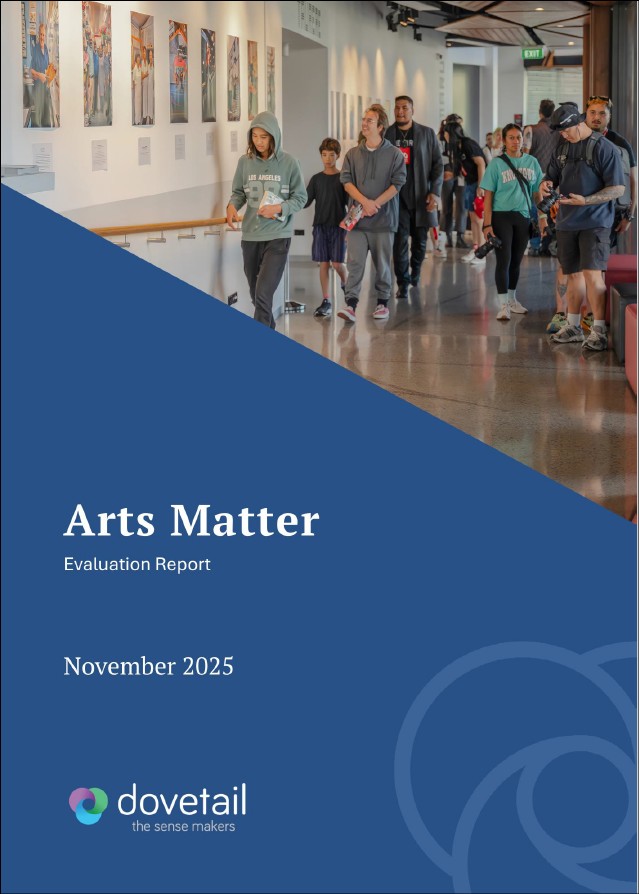
Arts matter evaluation report
Author:
Dovetail Consulting, Adrian Field, Amanda Hunter, Georgia Parslow, Cat RukaSource:
Dovetail Consulting | Auckland CouncilPublication date:
2026Topics:
PeopleA value for investment evaluation of the value of arts investment by Auckland Council in Tāmaki Makaurau.
Executive summary
Background and approach
Auckland Council plays a key role in shaping the arts and culture landscape of Tāmaki Makaurau through investments in programmes and infrastructure to support the sector. Amid growing scrutiny over public spending and critiques of the economic return and cultural value of such investments, the case for sustaining investment in arts and culture has become a pressing policy consideration.Auckland Council commissioned Dovetail Consulting to carry out a Value for Investment evaluation of Auckland Council’s investment in arts and culture. The purpose of this evaluation is to capture and explore the impact of Auckland Council arts and culture investments and the value they offer for Auckland communities. The evaluation draws on a series of six case studies that profile the value of arts investment by Auckland Council across Tāmaki Makaurau.
The case studies
T he following case studies were developed to illustrate the different ways Auckland Council’s investment in arts and culture is experienced across the city. Each example highlights a distinct type of investment and demonstrates how these contribute to outcomes such as community cohesion, cultural expression, sector capability, and local economic vitality. The case studies cover the following key investment areas:
- Pride Fest Out West: A festival that celebrates Rainbow communities in West Auckland, supported through Auckland Council’s investment in programming.
- Te Manu Ka Rewa: A public artwork created by an emerging mana whenua artist Jadyn Flavell, demonstrating Auckland Council’s role in transforming public spaces through public art, uplifting Māori identity and culture, and embedding iwi narratives in the built environment.
- Stand Up Stand Out: A free, region-wide secondary school performance competition, exemplifying investment in rangatahi and talent development that nurtures emerging artists and creative pathways.
- Basement Theatre: An independent theatre supported by Auckland Council venue subsidies and strategic grant funding, representing investment in spaces that sustain independent arts and provide pathways for emerging talent.
- Te Oro: A purpose-built rangatahi (youth) and community arts facility in Glen Innes, reflecting investment in infrastructure that provides access to creative programming, creative residencies, and community events.
- Dragon Boat Festival: A celebration of Chinese tradition and an investment in culture, heritage and identity that fosters intercultural connection and belonging.
In what ways does investment in arts deliver value for Tāmaki Makaurau?
Auckland Council’s investment in arts and culture takes many forms and moves beyond funding to include staff resourcing, venue provision and subsidisation and capacity building. These investments are made into festivals and creative programming, rangatahi and talent development, infrastructure and spaces, public art, and initiatives that celebrate cultural heritage and identity. These investments, ranging from full funding through to small subsidising and grant contributions, generate wide-ranging benefits. They bring communities together in safe and inclusive ways, enable cross-cultural connections, create platforms for cultural storytelling, and nurture emerging talent through pathways into sustainable arts careers. Infrastructure and public art build enduring taonga and vibrant communities, while festivals and cultural programmes strengthen cohesion, support local economies, and make creativity accessible to all.
To what extent does Auckland Council’s arts investment demonstrate value?
Through the design process, we established a set of criteria and standards, detailed in rubric tables (Appendix 1: Evaluation rubric). A rubric outlines levels of performance for the programmes that were just good enough or excellent. We found that performance against criteria is generally strong with all meeting expectations, and most either on a pathway to excellence or reaching excellence.
Lessons for future investment
This evaluation has highlighted that the success of Auckland Council’s arts and culture investment relies on more than funding. Integrated and tailored support which can include sector expertise, subsidised venues, and capacity-building were all investments that were important in achieving outcomes. The council’s role in brokering relationships helped connect initiatives with wider networks. Council funding often acted as a foundation that enabled other funders to contribute, making co-investment a key factor in ensuring long term sustainability. Cultural responsiveness was another key enabler, with co-design approaches and the uplifting of ngā toi Māori being central to outcomes.
There are also several opportunities to strengthen future investments, including ensuring that operational funding keeps pace with programme growth, providing additional capacity-building support for fledging initiatives, and embedding culturally responsive contract and accountability mechanisms. Guidance on Te Tiriti-centred practice, continuity of Council staff expertise, and developing simple outcome monitoring tools could also strengthen delivery.
Through the lens of case studies, Auckland Council’s arts investments contribute to key strategies and frameworks, including Toi Whītiki (arts strategy), Auckland Plan 2050, Ngā Hapori Momoho/Thriving Communities Strategy, and Tāmaki Ora 2025-27.
Conclusion
Auckland Council’s investment in arts and culture generates cultural and social value for communities across Tāmaki Makaurau, with modest economic benefits also captured through this evaluation. Through an exploration of six case studies this evaluation has explored how council’s investment in arts and culture activities can foster increased community engagement and participation, uplift diverse communities, strengthen cohesion and build pathways for artists to sustain careers in the creative industries.
Investment sites show that value is not achieved through operational funding alone, but through a mix of resources, relationships and culturally responsive approaches. Looking to the future, the opportunities to generate further value from investment hinges on a number of areas for improvement that have been outlined in this report.
Dovetail Consulting, Auckland Council, November 2025
See also
Case studies