Auckland urban heat assessment – Future climate. Technical report
Author:
Arup New Zealand LimitedSource:
Auckland Council Chief Sustainability Office, Arup New Zealand LimitedPublication date:
2026Topics:
EnvironmentExecutive Summary
Cities are becoming hotter due to both climate change and the urban heat island (UHI) effect, where temperatures in urban areas are higher than surrounding rural regions. These rising temperatures increase risks to public health, wellbeing, and critical infrastructure, meaning that understanding how heat is distributed across the city—and how it may worsen in the future—is essential.
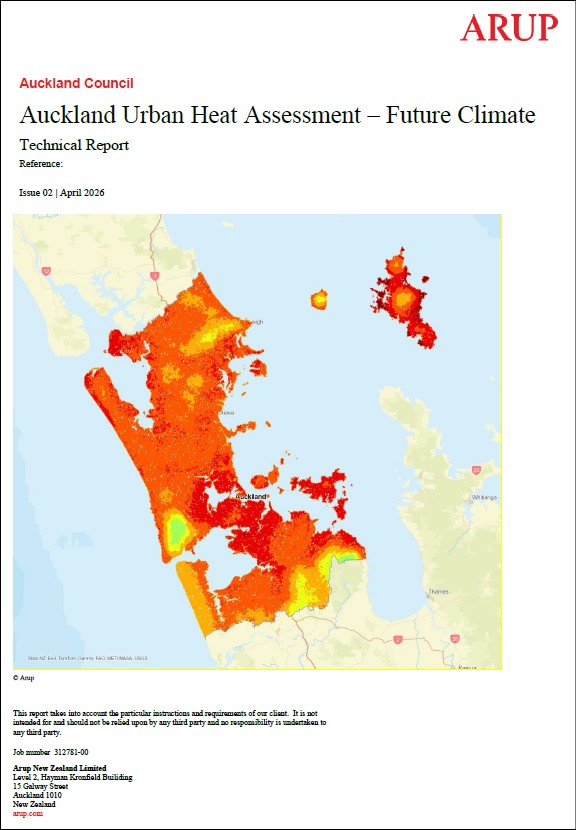
Auckland Council commissioned Arup in 2024 to create a detailed urban heat dataset (Arup, 2024). This study builds on that work, by examining how climate projections could influence Auckland’s UHI effect in the future and assessing the impacts of future extreme heat events.
Methodology
The study used the latest climate change projections for New Zealand to analyse future urban heat conditions. Two future time periods 2050 (2041 – 2060) and 2090 (2080-2099) and three emission scenarios SSP1-2.6, SSP2-4.5 and SSP3-7.0 were analysed.
Future heat maps for Auckland were produced using a method that applies climate change projections to adjust the present-day urban heat dataset. These were produced for average summer conditions and summer heat events, which were derived through examining exceedances of temperature-based thresholds.
More detailed climate analysis—such as using a combination of WRF and Arup’s UHeat tool—was not undertaken for this work. Although such an approach is possible, our simplified method was considered the most practical way to provide an indication of likely future conditions. The method followed focused on temperature changes and does not consider other environmental variables or future land use changes.
Key Findings
Future climate projections show a clear and consistent increase in summer temperatures across Auckland, with warming increasing under higher emissions scenarios and toward the end of the century. By 2090, average summer temperatures in the hottest areas could reach 23°C, with maximum daily temperatures averaged over the extended summer season exceeding 27°C.
Building on the future climate analysis of average conditions, current and future heat events were analysed, including hot days, very hot days, hot nights and heatwaves during both daytime and night-time periods. Results indicate a substantial increase in the frequency and duration of heat events, particularly under higher emissions scenarios. Our analysis over Auckland shows:
- Hot days (>25°C) double by 2050 and increase more than fivefold by 2090 (SSP3-7.0).
- Very hot days (>30°C) are rare in most climate scenarios and future periods, apart from SSP3-7.0 where, by 2090, temperatures above 30°C are seen 2.8 days over an extended summer season.
- Heatwaves become more frequent and longer, with the longest daytime heatwave growing from ~4 days (baseline) to over 20 days by 2090 (SSP3-7.0).
- Night-time heat events also rise dramatically, with heatwave frequency and duration more than doubling by 2090 (SSP3-7.0).
While regional averages are presented for heat events, they are not spatially uniform. Urban areas experience higher temperatures and more frequent heat events than the Auckland average.
Conclusions
Auckland is expected to face increasing heat risk due to the combined influence of climate change and the urban heat island effect. This future climate assessment improves understanding of the temperatures likely to be experienced in urban areas, extending beyond changes in average conditions, to show how hot days and hot nights, as well as the frequency and duration of heatwaves, are projected to increase over time.
The study shows how elevated temperatures impact a wider area of the region in the future. The locations of urban heat hotspots, which represent areas where temperatures are elevated relative to their local surroundings, remain broadly consistent with the baseline. However, as future temperatures increase, the analysis enables a deeper understanding of how hot these hottest areas across Auckland can get and how priority areas identified in the baseline study will change in the future.
These findings highlight the importance of integrating heat considerations into urban design, green infrastructure, and mitigation planning, to strengthen Auckland’s heat resilience and protect infrastructure and community wellbeing. The study could be further extended to include modelling population growth, land‑use change, and additional climate variables such as wind and humidity, to provide a more complete picture of future urban heat risks.
Auckland Council, March 2026
See also
Auckland urban heat assessment. Technical report 2024
Online resources
Auckland's predicted air temperature distribution (Nov 2021-Mar 2022) (Auckland Council Open Data)